


Friends,
The contentious U.S. presidential election is over. Depending on one’s personal preference, it’s understandable that some readers are disappointed—and others elated—at the results. When it comes to investing, however, these emotions must be set aside. History makes it clear that the stock market has no political preference.
Our message to investors this week, and in future weeks/months as the transition of power takes place, is clear: stay focused on your objectives and remember what it takes to achieve them. And that is, an asset allocation that’s aligned with your long-term goals, income needs, risk tolerance, and one that’s driven by economic fundamentals and corporate earnings. Short-term political outcomes should be walled off from these considerations.
In the short term, the removal of uncertainty around the election and President-Elect Trump’s pro-business agenda has led to higher stock prices and lower bond prices /higher interest rates. However, it’s too early to draw strong conclusions or make aggressive predictions as to the ultimate impact of the new administration’s policies on the economy and markets. For example, deregulation, tax cuts and a pro-business environment should be positive; across the board tariffs, mass deportations and higher fiscal deficits may be negative. Only time will tell.
History reminds us to keep our cool. Since the inception of a version of the S&P 500 in the 1920’s1, there have been 24 U.S. presidential elections. In 20 of them, the S&P 500 Index registered positive total returns. In the four instances when the stock market fell, the U.S. economy was in the Great Depression, the early days of World War II, the 2000 tech bubble, and the 2008 Global Financial Crisis.
The chart below drives this point home. If a person invested money in the stock market only when their preferred political party was in the White House, it would have meant severely reducing total return over time. This is true of both Democrats and Republicans. Investing for the long-term—regardless of who was president—clearly delivered the best result.
Growth of $10,000 (1948-2023):
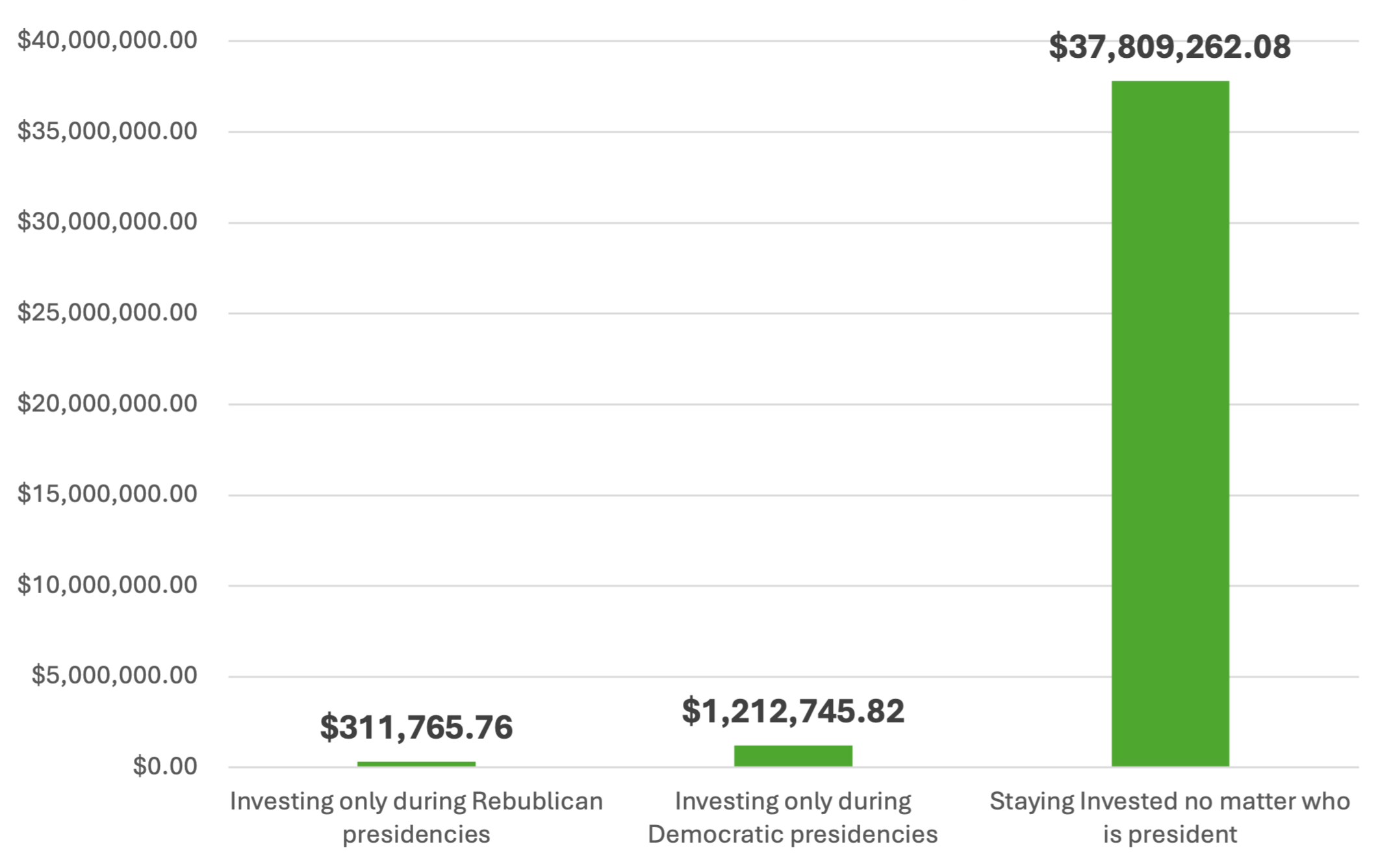
Source: Data from Morningstar, Charles Schwab
Regardless of politics, there are good reasons to be optimistic: Today we have 4% unemployment, roughly 2.5% inflation, 2+% GDP growth, and solid corporate earnings growth. In addition, we have a Fed who would like to lower interest rates over the next year as long as inflation remains manageable. These are all bullish indicators, and they are the data points that matter.
Let us know if you’d like to discuss any of this or if we can do anything for you. Thanks!
Matt and Andrew